From Ambiguity to Execution: Building a 127-Item Product Delivery Baseline in GitHub
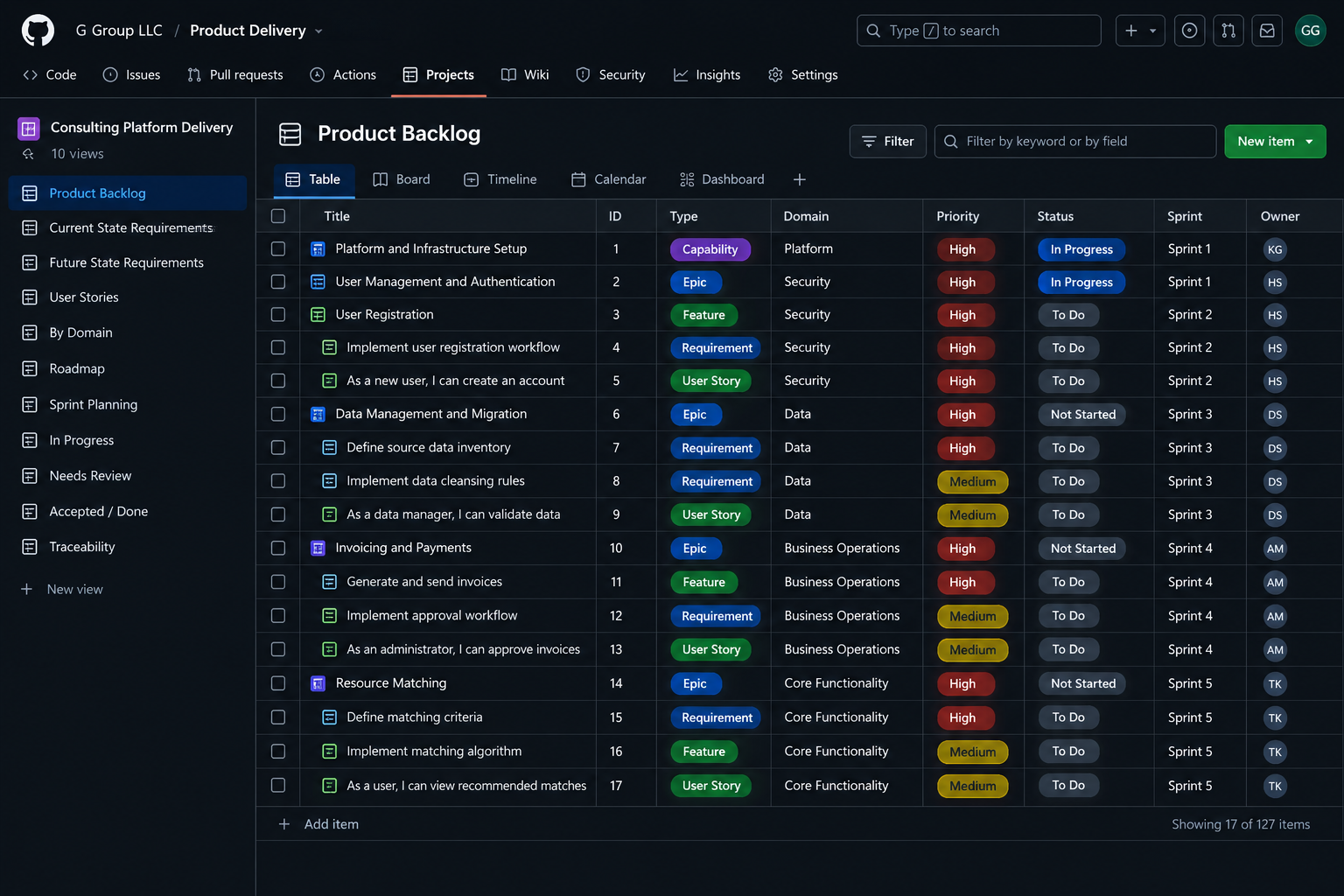
Representative Backlog
It is easy to talk about product management at a high level. The more difficult work starts when someone has to translate an evolving platform, competing ideas, incomplete requirements, and future ambitions into something a development team can actually execute.
G Group recently had the opportunity to do exactly that as part of a prospective engagement involving a boutique consulting technology platform.
The objective was straightforward: take an evolving set of platform capabilities and requirements and turn them into a structured product delivery baseline that could support prioritization, backlog management, sprint planning, and product governance.
The result was a 127-item product and delivery baseline managed through GitHub Projects.
Getting Into the Details
The starting point was not a neatly packaged requirements specification. Like many growing technology initiatives, the platform contained a mix of existing functionality, planned capabilities, emerging ideas, user needs, and architectural considerations.
The first task was therefore to create structure.
G Group reviewed the available platform information and organized the work into 10 functional product domains. Within that structure, we documented 52 current-state requirements, 48 future-state requirements, and 17 user stories.
That distinction between current and future state mattered.
Without it, a backlog can quickly become a flat list of ideas with no clear indication of what already exists, what must change, what is genuinely new, and what should come first.
Turning Requirements Into a Delivery Model
Requirements alone do not create an executable product plan.
The next step was to organize the information into a product hierarchy that could support actual delivery management. GitHub Projects became the working environment for structuring and tracking the baseline.
The hierarchy connected higher-level capabilities to epics, features, and user stories, creating a clearer line between strategic intent and actionable development work.
This created the foundation for backlog prioritization, Sprint 0 activities, future sprint planning, roadmap development, dependency management, and ongoing product governance.
The value was not GitHub itself. GitHub was the enabling tool.
The real value came from converting a rapidly evolving collection of product information into a management structure that could be reviewed, challenged, prioritized, and executed.
The Numbers Tell Part of the Story
The resulting baseline contained 127 structured product and delivery items across 10 domains, including 52 current-state requirements, 48 future-state requirements, and 17 user stories.
Those numbers matter because they demonstrate the amount of information that can sit behind what initially appears to be a relatively simple technology platform.
They also illustrate why experienced project, product, and requirements management still matters in an agile environment.
Agility does not eliminate structure. Effective agility depends on having enough structure to understand what is being built, why it matters, how individual pieces relate to each other, and what decisions need to be made next.
GitHub as a Management Environment
GitHub is commonly viewed primarily through the lens of software development and source-code management.
For this work, GitHub Projects also served as a practical management environment.
It provided a place to organize the product baseline, establish relationships among delivery items, manage the emerging backlog, and create visibility into the work that would need to move through future development cycles.
For a management consultant working at the intersection of business and technology, that is an important distinction.
The objective is not to become the developer. The objective is to make sure business requirements, user needs, priorities, risks, and delivery activities are structured well enough for the technical team to execute effectively.
Experienced Practitioners Still Need to Get Their Hands Dirty
There is a tendency in consulting for senior practitioners to move progressively farther away from the underlying work.
That can create risk.
Strategic oversight is important, yet sometimes the fastest way to understand a complicated initiative is to get directly into the requirements, backlog, workflows, tools, and delivery details.
This exercise reinforced that principle.
Working directly in GitHub, examining individual requirements, distinguishing current from future state, developing user stories, and organizing the product hierarchy provided a much clearer understanding of the platform than a high-level review alone could have produced.
That detailed understanding then makes higher-level recommendations more useful.
From Product Baseline to Execution
A product delivery baseline is not the end state.
It is the starting point for better execution.
Once the work is structured, leadership can make better decisions about priorities, sequencing, resources, architecture, dependencies, and delivery cadence. Product owners can manage a more disciplined backlog. Development teams receive clearer inputs. Stakeholders gain greater visibility into what is being built and why.
That is where management consulting, product management, project management, and technology delivery intersect.
At G Group, this is the type of practical work we increasingly focus on: taking complicated or loosely structured initiatives and converting them into something organizations can manage and execute.
Whether the need involves a technology platform, PMO, transformation initiative, Digital HQ, or another business and technology challenge, sometimes the most valuable first step is simply creating enough structure to move forward.
G Group LLC
Management Consulting | PMO | Transformation | Digital Collaboration | Business & Technology Delivery