Digital HQ: A Practical Ladder from Scattered Work to Structured Growth
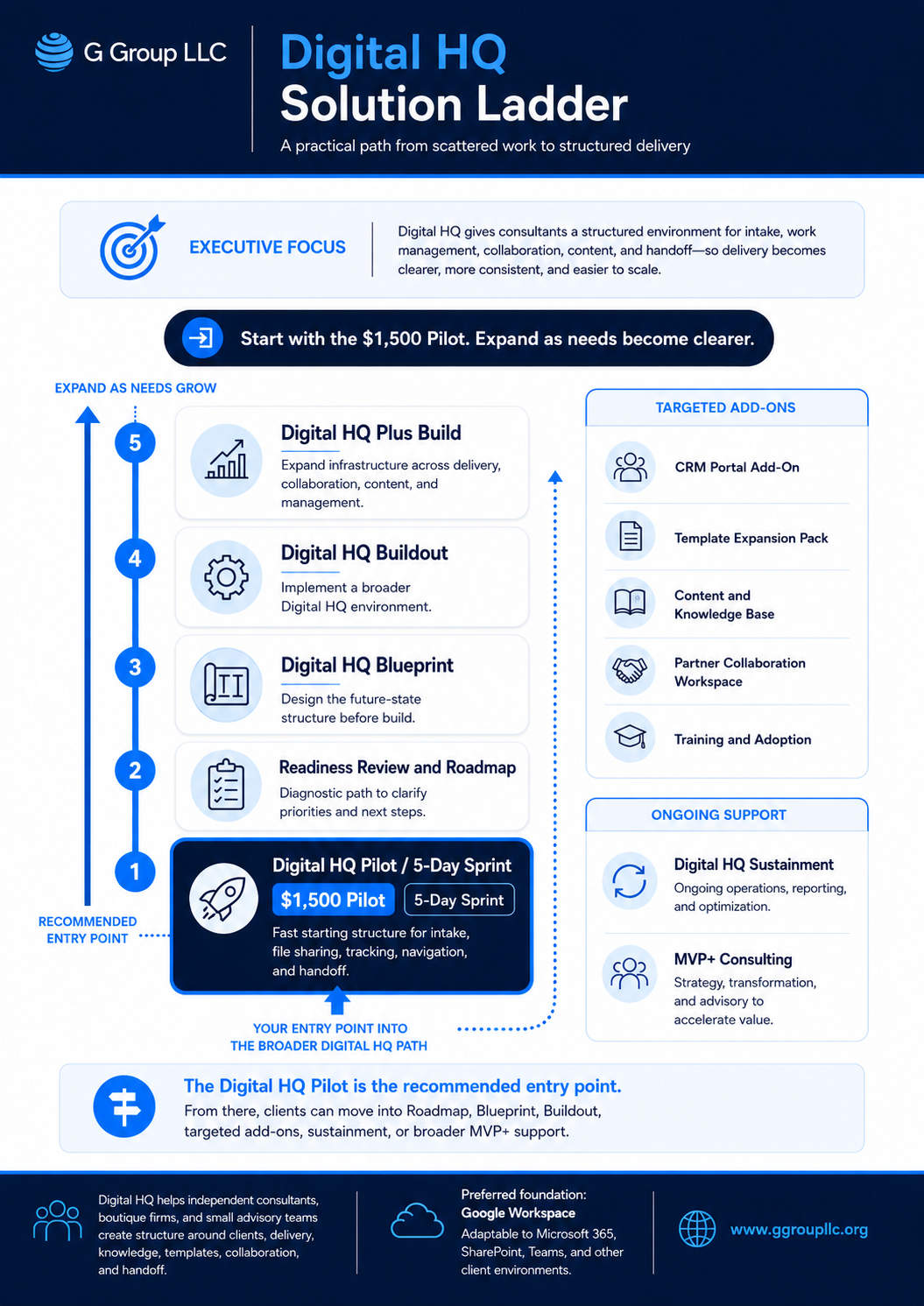
Digital HQ Solution Ladder
Independent consultants, boutique firms, fractional executives, and specialist delivery teams often reach the same point in their growth journey.
The work is real. The expertise is credible. The client relationships are forming. The delivery capability exists.
The problem is that the business still runs through scattered documents, individual memory, disconnected folders, manual follow-ups, and improvised client communication. AND INERTIA TO NOT ADDRESS THE CHALLENGE IS STRONG - AND NOT YOUR CORE SPECIALTY.
That may work at the very beginning. It does not scale well.
As the number of clients, prospects, collaborators, proposals, delivery assets, and follow-up actions increases, the firm needs more than effort. It needs a structured working environment that supports repeatable delivery, clearer client engagement, and practical growth.
That is the purpose of Digital HQ.
Digital HQ is not just a portal
Digital HQ is not simply a website, a shared drive, a client portal, or a software product.
It is a practical business system for organizing how a firm works with clients, manages delivery, captures knowledge, coordinates collaborators, and moves from ad hoc effort to repeatable execution.
For many small firms, the first version does not need to be large or complicated. It needs to be useful, credible, and operational.
That is why G Group frames Digital HQ as a ladder.
The ladder creates a clear path from an initial pilot to a more complete consulting infrastructure. Each step builds on the prior step, and each step should produce something the firm can actually use.
The Digital HQ ladder
The ladder begins with a focused pilot and then expands through structured levels of capability.
| Stage | Purpose | Typical Focus |
|---|---|---|
| Digital HQ Pilot | Prove value quickly | Assess the current environment, define the initial structure, and build a practical starting point. |
| Level 1: Foundation | Create basic structure | Organize core folders, templates, intake points, and client-facing materials. |
| Level 2: Operating | Improve repeatability | Add delivery workflows, management routines, status tracking, and collaboration discipline. |
| Level 3: Scaled | Support growth | Strengthen knowledge management, partner coordination, delivery governance, and reusable assets. |
| MVP+ | Extend into broader consulting support | Use Digital HQ as the base for ongoing support, transformation, PMO, advisory, and implementation work. |
The logic is simple. Start small enough to act, then expand only where the business case is clear.
Why the pilot matters
Many firms delay operational improvement because they assume it requires a major technology project.
It usually does not.
A focused Digital HQ pilot gives the firm a bounded way to test the concept, clarify priorities, and create an initial working environment within a short delivery cycle.
The pilot is not intended to solve every operating issue. It is intended to show what better structure looks like in practice.
A strong pilot should help answer several practical questions:
Where is work currently scattered?
What information should clients, collaborators, or internal team members be able to find quickly?
Which templates, workflows, or knowledge assets are used repeatedly?
Where does the firm lose time due to unclear structure or manual coordination?
What should be standardized now, and what should wait?
The output should not be a theoretical roadmap only. It should include a usable starting point.
Built in five-day business sprints
Digital HQ is designed around five-day business sprints.
This is important because the work should move at the pace of a growing firm, not the pace of a large internal transformation program.
A typical sprint follows a practical sequence:
| Sprint Step | Focus | Practical Output |
|---|---|---|
| Day 0: Prepare | Confirm objectives, inputs, access, priorities, and working assumptions. | A clear sprint scope, agreed working priorities, source materials, access requirements, and decision points. |
| Days 1 to 2: Structure | Define the operating need, information flow, workspace design, and user experience. | A practical Digital HQ structure covering core folders, user paths, management areas, client-facing needs, and initial content organization. |
| Day 3: Build | Create or configure the initial workspace, templates, folders, and working assets. | A usable first version of the Digital HQ environment, including selected templates, workspace sections, and priority business assets. |
| Day 4: Refine | Review usability, improve structure, organize client-facing or collaborator-facing elements, and address gaps. | A cleaner, more usable Digital HQ with improved navigation, clearer content placement, and practical refinements based on review. |
| Day 5: Handoff | Walk through the solution, document key decisions, confirm next steps, and identify future enhancement priorities. | A working handoff package, documented recommendations, operating guidance, and a prioritized path for future Digital HQ maturity. |
This structure brings discipline without overbuilding. It also allows the firm to make decisions weekly, review progress quickly, and reprioritize based on what is actually useful.
Capability-based, not size-based
The Digital HQ ladder is not primarily based on company size.
A solo consultant may need Level 2 capability if they manage several clients, proposals, subcontractors, and repeatable delivery assets. A boutique firm may only need Level 1 if its work is still simple and relationship-driven.
The better question is not, “How big is the firm?”
The better question is, “What operating capability does the firm need next?”
Capability-based design keeps the offer practical. It avoids forcing a small firm into a large implementation. It also prevents a growing firm from staying stuck with tools and habits that no longer fit.
What changes when Digital HQ works
A good Digital HQ creates visible improvements in how the business operates.
The firm should be able to move from:
| From | To |
|---|---|
| Scattered files | Organized working environment |
| Manual follow-up | Clear management routines |
| Recreating documents | Reusable templates and assets |
| Informal client communication | Structured client collaboration |
| Individual memory | Shared knowledge base |
| Ad hoc delivery | Repeatable delivery discipline |
| Unclear growth path | Practical capability roadmap |
This is not about adding complexity. It is about reducing friction.
The goal is to help the firm spend less time searching, rebuilding, explaining, and coordinating, and more time selling, delivering, and improving.
Where Digital HQ fits in the G Group solution stack
Digital HQ sits within G Group’s broader practical consulting model.
| G Group Offer | How Digital HQ Supports It | Practical Business Value |
|---|---|---|
| MVP Collaboration | Provides the basic structure a firm needs to work more professionally with clients, collaborators, and delivery partners. | Creates a clearer working environment for client materials, shared files, intake, communication, and early collaboration routines. |
| MVP Consulting | Strengthens delivery routines, reusable methods, templates, and client engagement practices as the firm matures. | Helps the firm move from one-off delivery to more repeatable consulting execution, clearer project management, and more consistent client experience. |
| MVP+ | Connects Digital HQ to broader consulting support, including PMO, transformation, implementation, advisory, and ongoing operational improvement. | Uses Digital HQ as a foundation for larger consulting engagements, expanded delivery support, and structured business improvement over time. |
It helps a firm improve how it works now, while also creating the structure needed for more advanced consulting and delivery support later.
A practical example
Consider a small consulting firm that has begun to gain traction. It has a website, service descriptions, proposals, prospect lists, draft templates, client notes, and delivery materials. Some information sits in Google Drive. Some remains in email. Some is buried in old presentation files. Some still depends on the founder’s memory.
The firm does not need a large enterprise system. It needs a clear place to manage the basics.
| Business Need | Digital HQ Response | Practical Result |
|---|---|---|
| Prospect follow-up | Simple intake and tracking structure | Prospects, next steps, notes, and follow-up actions are easier to manage without relying only on inbox memory or informal lists. |
| Client delivery | Organized project folders and status routines | Client work has a clearer structure for deliverables, meeting notes, decisions, issues, and progress tracking. |
| Repeatable work | Templates, checklists, and standard deliverables | The firm spends less time recreating common materials and more time improving the quality of its delivery assets. |
| Collaboration | Shared workspace for team members or partners | Collaborators can access the right materials, understand their role, and work from a common operating structure. |
| Knowledge | Curated assets, examples, and reusable methods | Important experience, methods, examples, and lessons are captured in a way that supports reuse and future delivery. |
| Growth | Roadmap for additional capability over time | The firm can expand its Digital HQ with discipline instead of adding tools, folders, and processes in an ad hoc way. |
That is the practical value of the ladder. It helps the firm build what it needs now, while creating a disciplined path to expand over time.
Why this matters now
Small firms are under pressure to look credible, respond quickly, use AI effectively, manage distributed work, and collaborate across networks of specialists.
At the same time, many do not need heavy enterprise systems. They need a structured, professional way to work.
Digital HQ addresses that middle ground.
It is practical enough for a solo consultant or boutique firm. It is structured enough to support growth. It is flexible enough to work with common business tools such as Google Workspace and adaptable to other environments where needed.
Most importantly, it reflects a traditional consulting principle: define the operating requirement before choosing the tool.
Technology should support the business model. It should not substitute for one.
The bottom line
Digital HQ helps firms move from scattered work to structured growth.
The ladder makes that transition manageable.
Start with a focused pilot. Build the foundation. Add operating discipline. Scale the knowledge and delivery model. Then use that structure as the base for broader consulting, transformation, and implementation support.
For firms that are growing beyond individual effort, that structure is not administrative overhead.
It is part of the business model.