Reconnecting Strategy and Execution | MBB × Big 4 Lead Assessment Framework
White Paper
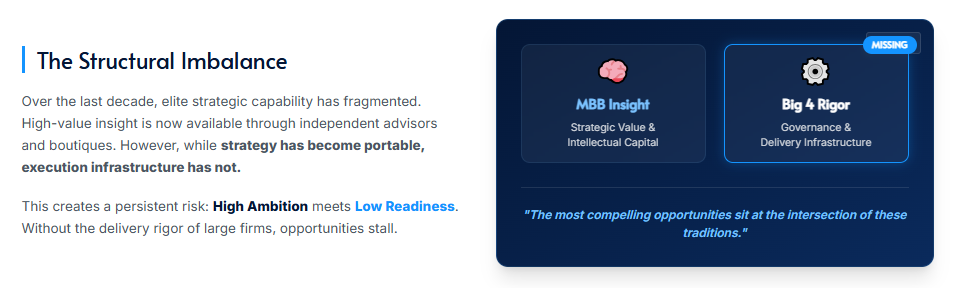
Over the past decade, the consulting market has changed in a fundamental way. Strategic capability, once tightly held within large firms, has become widely distributed. Independent consultants and boutique firms now routinely deliver MBB-level insight, deep sector expertise, and senior executive advisory support.
Execution capability, however, has not dispersed at the same rate.
This imbalance has become one of the defining challenges of modern consulting. Strategy has become portable. Delivery infrastructure has not. As a result, many high-quality consulting opportunities fail to reach their potential, not because of weak ideas, but because execution maturity does not match strategic ambition.
This article explores why reconnecting strategy and execution is now a leadership imperative and how a structured lead assessment framework can help consulting firms and independent advisors close that gap.
The New Reality of the Consulting Market
Clients today are more willing than ever to engage independent consultants and boutique firms. They value specialization, flexibility, and direct access to senior expertise. This shift has unlocked extraordinary talent across industries and geographies.
At the same time, many advisors operate without the institutional scaffolding that historically supported large-firm delivery. Client onboarding, delivery governance, collaboration, security, and knowledge management are often handled through informal or improvised mechanisms. While this approach may work in early stages, it introduces risk as engagements grow in complexity, scale, or visibility.
The result is a quiet friction in the market. Demand exists. Capability exists. Yet trust, scalability, and consistency remain uneven.
Why Traditional Lead Qualification Falls Short
Most lead qualification processes focus on surface indicators. Industry fit. Budget size. Relationship strength. Availability. These factors matter, but they do not address the core issue facing many consulting organizations today.
The real question is not simply whether a lead is attractive. The question is whether the consulting organization is structurally prepared to deliver on the promise implied by that lead.
Strategy to Implementation Imbalance
Without a disciplined way to assess execution readiness alongside strategic value, firms risk overcommitting, underdelivering, or misallocating scarce leadership attention. In this environment, lead assessment must evolve from a sales filter into a strategic enablement capability.
A Dual-Lens Approach to Lead Assessment
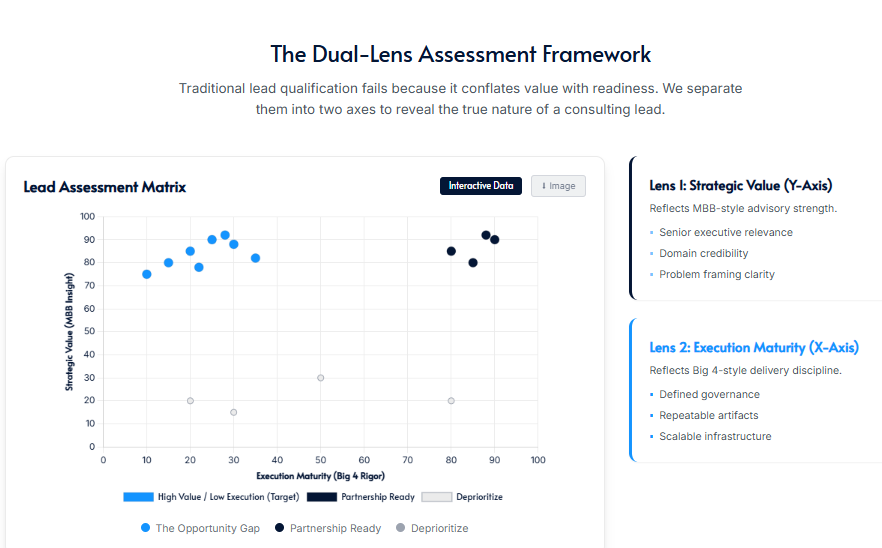
Reconnecting strategy and execution requires separating two dimensions that are often conflated.
The first is strategic value. This reflects the strengths traditionally associated with top-tier strategy consulting. Depth of insight. Clarity of problem framing. Senior client access. Domain credibility. High strategic value indicates influence and relevance at the decision-making level.
The second is execution maturity. This reflects the disciplines historically refined within Big 4 environments. Governance. Repeatable delivery models. Professional infrastructure. The ability to scale beyond the individual consultant.
Duel Lenses
Each dimension matters independently. True opportunity emerges when they are evaluated together.
Many of the most promising leads in today’s market exhibit high strategic value paired with limited execution maturity. This gap represents risk if ignored, and opportunity if addressed deliberately.
From Assessment to Action
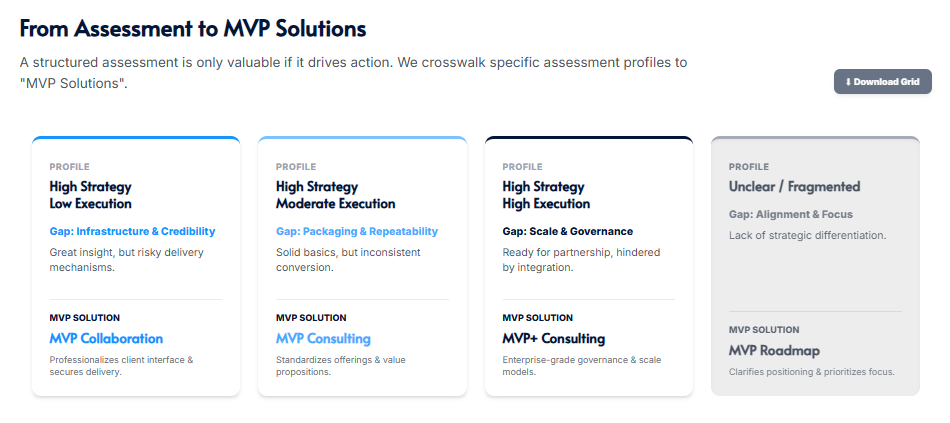
A structured assessment framework enables more than prioritization. It informs how an organization should engage.
Leads with strong strategic value but weak execution maturity benefit from targeted enablement. The focus shifts from additional strategy work to strengthening delivery credibility and infrastructure.
Leads with both high strategic value and high execution maturity may warrant partnership or co-delivery models that emphasize leverage rather than remediation.
Leads with limited strategic value, regardless of infrastructure, should be deprioritized. Execution support cannot compensate for a lack of meaningful advisory relevance.
This approach replaces generic selling with evidence-based positioning and allows leadership teams to align resources with real, observable need.
Applying the Framework in Practice
Within G Group, this assessment discipline is operationalized through the G Group Enablement Modules, known internally as GEMs. The methodology evaluates leads across strategic value and execution maturity, then segments them based on observable profiles.
The value of this approach is not the scoring itself. The value lies in the clarity it creates. By making the gap between strategy and execution explicit, engagement narratives become sharper, delivery models become more appropriate, and expectations are aligned from the outset.
MVP Solutions
Rather than offering uniform solutions, responses are tailored to maturity, readiness, and ambition. This discipline strengthens trust and improves long-term outcomes for both clients and advisors.
Why This Matters for Consulting Leaders
The separation of strategy and execution is not new. What is new is the degree to which individual consultants and boutique firms must now reconcile both within their own operating models.
Leaders who adopt a structured lead assessment approach gain tangible advantages. They prioritize better. They protect credibility. They scale more deliberately. Most importantly, they restore the link between thinking and doing that has always defined effective consulting.
In a crowded market filled with strategic claims, execution capability increasingly serves as the differentiator.
Moving Forward
Strategy without execution remains aspirational. Execution without strategy remains commoditized. The future of consulting belongs to those who intentionally integrate both.
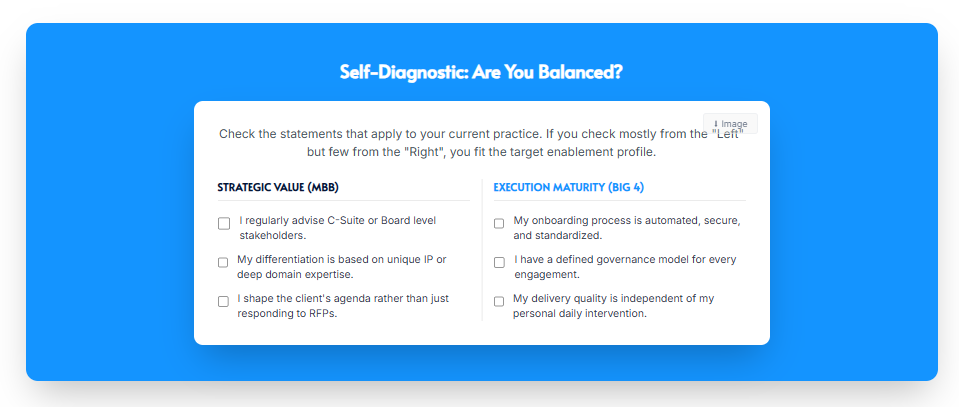
Self Diagnostic
A structured lead assessment framework provides a practical way to do exactly that. It elevates lead qualification from a transactional activity to a leadership discipline and enables consulting organizations to grow with integrity, credibility, and focus.
For those navigating growth, scale, or transition in today’s consulting environment, the question is no longer whether strategy and execution must be reconnected. The question is whether that reconnection will be deliberate or accidental.